 Posted by
 is well known as the most advanced opensource database, and it helps you to manage your data no matter how big, small or different the dataset is, so you can use it to manage or analyze your big data, and of course, there are several ways to make this possible, e.g Apache Spark. In this blog, we’ll see what Apache Spark is and how we can use it to work with our PostgreSQL database.
For big data analytics, we have two different types of analytics:
- Batch analytics: Based on the data collected over a period of time.
- Real-time (stream) analytics: Based on an immediate data for an instant result.
What is Apache Spark?
Apache Spark is a unified analytics engine for large-scale data processing that can work on both batch and real-time analytics in a faster and easier way.
It provides high-level APIs in Java, Scala, Python and R, and an optimized engine that supports general execution graphs.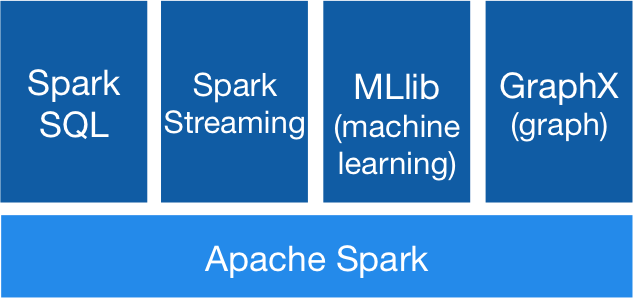 Apache Spark Components
Apache Spark Libraries
Apache Spark includes different libraries:
- Spark SQL: It’s a module for working with structured data using SQL or a DataFrame API. It provides a common way to access a variety of data sources, including Hive, Avro, Parquet, ORC, JSON, and JDBC. You can even join data across these sources.
- Spark Streaming: It makes easy to build scalable fault-tolerant streaming applications using a language-integrated API to stream processing, letting you write streaming jobs the same way you write batch jobs. It supports Java, Scala and Python. Spark Streaming recovers both lost work and operator state out of the box, without any extra code on your part. It lets you reuse the same code for batch processing, join streams against historical data, or run ad-hoc queries on stream state.
- MLib (Machine Learning): It’s a scalable machine learning library. MLlib contains high-quality algorithms that leverage iteration and can yield better results than the one-pass approximations sometimes used on MapReduce.
- GraphX: It’s an API for graphs and graph-parallel computation. GraphX unifies ETL, exploratory analysis, and iterative graph computation within a single system. You can view the same data as both graphs and collections, transform and join graphs with RDDs efficiently, and write custom iterative graph algorithms using the Pregel API.
Apache Spark Advantages
According to the official documentation, some advantages of Apache Spark are:
- Speed: Run workloads 100x faster. Apache Spark achieves high performance for both batch and streaming data, using a state-of-the-art DAG (Direct Acyclic Graph) scheduler, a query optimizer, and a physical execution engine.
- Ease of Use: Write applications quickly in Java, Scala, Python, R, and SQL. Spark offers over 80 high-level operators that make it easy to build parallel apps. You can use it interactively from the Scala, Python, R, and SQL shells.
- Generality: Combine SQL, streaming, and complex analytics. Spark powers a stack of libraries including SQL and DataFrames, MLlib for machine learning, GraphX, and Spark Streaming. You can combine these libraries seamlessly in the same application.
- Runs Everywhere: Spark runs on Hadoop, Apache Mesos, Kubernetes, standalone, or in the cloud. It can access diverse data sources. You can run Spark using its standalone cluster mode, on EC2, on Hadoop YARN, on Mesos, or on Kubernetes. Access data in HDFS, Alluxio, Apache Cassandra, Apache HBase, Apache Hive, and hundreds of other data sources.
Now, let’s see how we can integrate this with our PostgreSQL database.
How to Use Apache Spark with PostgreSQL
We’ll assume you have your PostgreSQL cluster up and running. For this task, we’ll use a PostgreSQL 11 server running on CentOS7.
 DayDreamsDatabases